
How to Stop Buddy Punching: 7 Ways GCC Employers Prevent Attendance Fraud
A supervisor at a Jebel Ali logistics yard noticed something odd in the monthly report. Three forklift operators had identical punch-in times for eleven consecutive days — to the minute. The swipe-card terminal had logged them faithfully. The problem was that only one of them had been standing in front of it.
That is buddy punching: one employee clocking in or out for another. It is the oldest form of attendance fraud, it survives every generation of technology that fails to verify who is punching, and in a region where overtime is paid by the hour and labour forces run into the hundreds, it quietly drains payroll every month.
The damage compounds. Paid hours that were never worked. Overtime triggered on shifts nobody attended. Disputes when a manager finally challenges a record. And a culture signal to every honest employee that the system can be gamed. The good news: buddy punching is almost entirely a solved problem once you combine the right verification method with a clear policy. This guide covers the seven controls that work, how to pick the ones you need, and how to roll them out without alienating your team.
Key takeaways
Buddy punching happens wherever the punch is not tied to a verified identity — cards, PINs, shared logins, and plain tap-to-clock apps are all exposed.
Face verification at the moment of punch is the single most effective control; geofencing and device binding close the remaining gaps.
Technology alone isn't enough: a written policy, visible audits, and fair shift rules remove the incentive.
A cloud attendance platform lets you apply these controls per location — biometric at the gate, verified mobile check-in on site — with one audit trail.
What Is Buddy Punching and Why Does It Persist?
Buddy punching (also called proxy attendance or proxy clocking) is when an employee records attendance on behalf of a colleague who is late, absent, or has already left. It typically takes one of four forms:
Card or fob sharing — the most common in UAE offices and warehouses with RFID terminals.
PIN sharing — keypad terminals or app logins passed between workmates.
Supervisor overrides — a line manager marks a whole crew present from a register or tablet without checking.
Unverified app punches — a basic mobile app where anyone holding the phone can tap "Clock in."
It persists because most attendance systems were designed to record time, not identity. A card terminal knows card #4471 was presented at 07:58; it has no idea who held it.
What buddy punching actually costs
Industry studies consistently place payroll leakage from time theft in the low single-digit percentages of total payroll. On a 500-employee labour force, even 2% is the equivalent of paying ten people who did nothing. Add overtime at the premium rates required under UAE Labour Law, and the real figure is often higher — because the hours most often faked are the ones that cross into overtime.
How to Prevent Buddy Punching: The 7 Controls
1. Verify the face, not the card
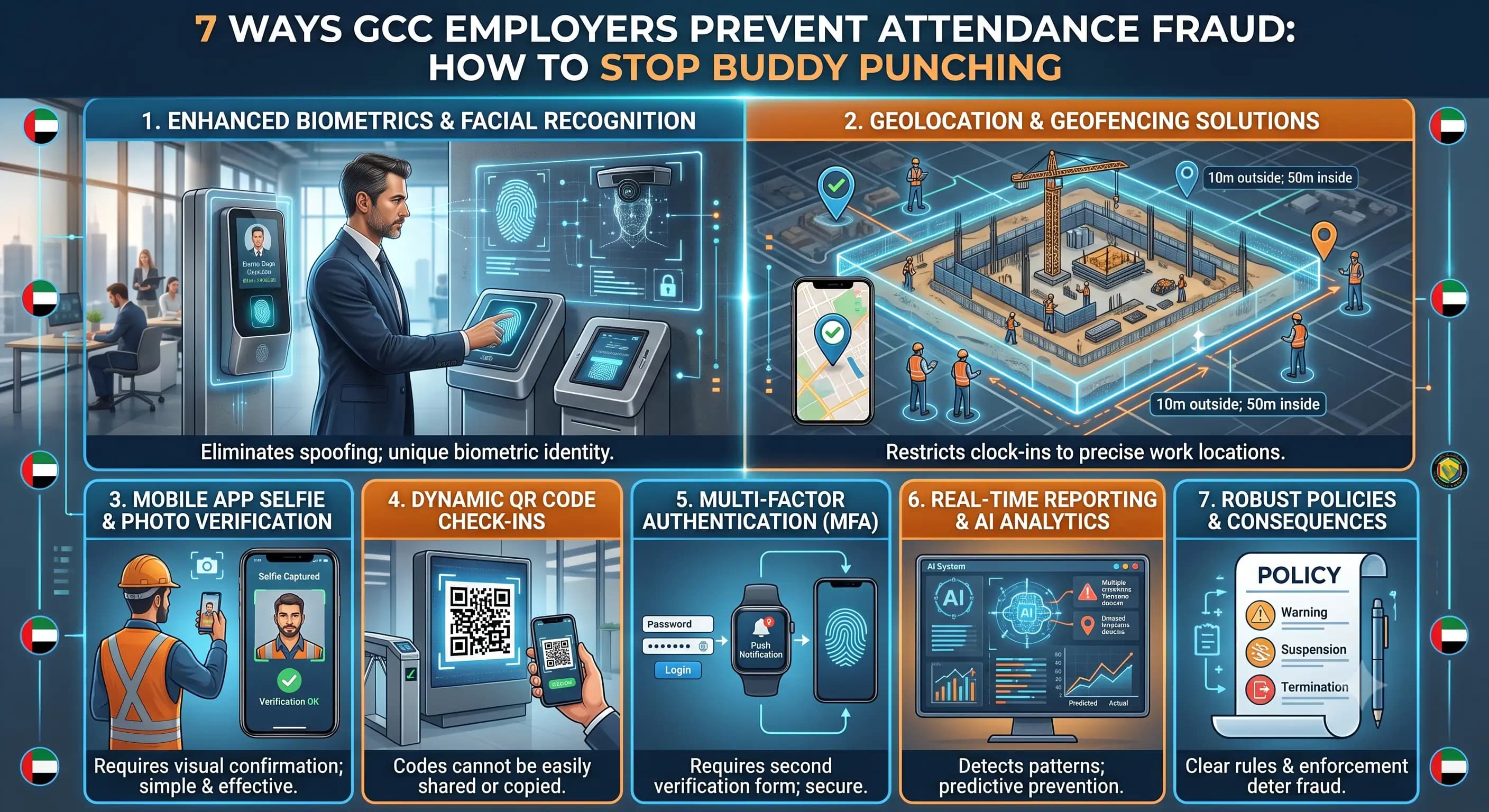
The single most effective control is a live face match at the moment of punching. Whether through a face-recognition terminal at the gate or a selfie check-in on a mobile app, the system compares the person in front of the camera to their enrolled template before accepting the punch.
What to look for:
Liveness detection — rejects a photo held up to the camera or a video on another phone.
Match on every punch, not just enrolment.
Works with PPE — the employee removes a helmet or mask for two seconds; it should not require a clean office environment.
Fingerprint readers achieve the same identity assurance but struggle in dusty, oily, or wet conditions, which is why many GCC industrial sites are moving to [face recognition attendance → /services/face-recognition-attendance].
2. Lock punches to a location with geofencing
Identity verification stops someone clocking in as a colleague. Geofencing stops someone clocking in for a colleague from the wrong place — the labourer who punches from the accommodation bus, or the sales rep who "arrives" at the showroom from home.
A geofenced attendance app:
Accepts a punch only within a defined radius of the assigned site.
Stores the GPS coordinates with the record for audit.
Flags mock-location apps and impossible travel (punched in Dubai at 08:00, Al Ain at 08:20).
For field teams, this is non-negotiable. Our [GPS geofencing attendance → /services/gps-geofencing-attendance] service covers the setup detail, including radius sizing for large sites.
3. Bind one device to one employee
A verified app on a shared phone is still a shared phone. Device binding registers each employee's handset at enrolment and refuses punches from any other device. If a worker changes phones, HR re-approves — a thirty-second task that removes an entire category of fraud.
Pair this with alerts when a single device attempts punches for more than one identity.
4. Put the clock in the shift rule, not the supervisor's hand
Manual registers and supervisor "mark all present" tablets are the weakest link on labour-heavy sites. Replace them with:
Automatic shift assignment, so the system already knows who is expected where and when.
Exception-based review, where supervisors only act on anomalies (late, missing, outside geofence) rather than confirming every punch.
Approval trails for any manual edit, with the editor's name, timestamp, and reason stored permanently.
When shifts are generated by rules rather than rebuilt weekly by hand, the opportunity to pad a crew list disappears. See [auto shift assignment → /services/auto-shift-assignment] for how this works across rotating patterns.
5. Make the audit visible
Fraud flourishes where nobody is looking. Three habits change behaviour fast:
Weekly anomaly report to site managers: identical punch times, punches outside geofence, overtime spikes by individual.
Random spot checks comparing the attendance record to the physical headcount on a given shift.
Employee self-service — when every worker can see their own punches in the app, a colleague's fake entry on their record becomes visible to them too.
The [real-time reporting and analytics → /services/real-time-reporting-analytics] dashboard surfaces most of these automatically; the point is that staff know it does.
6. Write a policy employees actually understand
Technology without policy creates resentment. A short, bilingual (Arabic/English) attendance policy should state:
Each employee must record their own attendance; recording for others is misconduct.
Which verification methods are used and why (fairness and accurate pay, not surveillance).
The grace period for late arrival and how late coming is treated.
The consequences, aligned with the disciplinary procedures permitted under UAE Labour Law — warnings first, escalation only for repeat offences.
How to report a technical failure (dead battery, no signal) so honest employees are never penalised.
Have every employee acknowledge it in the app during onboarding.
7. Remove the incentive
Buddy punching is often a symptom. Employees cover for each other when:
Transport from accommodation is unreliable and arrival times are not their fault.
Lateness penalties are severe relative to the delay.
Shift rosters change at the last minute.
Fix the root causes — realistic shift start times, transport coordination, a fair grace window — and the cover-for-a-mate culture weakens on its own.
Which Controls Do You Need? Match Them to Your Workforce
Workforce typeCore controlAddWhyOffice / corporateFace-verified mobile check-inDevice bindingEveryone has a phone; no hardware neededRetail / F&B outletsGeofenced selfie check-inException reports to area managersMulti-branch, high staff turnoverConstruction / manpowerFace terminal at camp gate + geofenced mobile on siteAuto shift assignment, kiosk modeMixed phone ownership, dusty conditionsHealthcareFace-verified mobile or terminalShift-rule enforcement for 24×7 rostersOvertime-heavy, compliance-criticalLogistics / field serviceGeofenced mobile with livenessImpossible-travel alertsStaff rarely pass a fixed device
For a broader comparison of the capture methods themselves, read [mobile attendance app vs biometric machine → /blog/mobile-attendance-app-vs-biometric-machine-uae].
A 30-Day Rollout Plan
Week 1 — Measure. Pull three months of punch data. Search for identical timestamps, round-number patterns, and overtime concentrated in a few individuals. This becomes your baseline and your business case.
Week 2 — Enrol. Capture face templates for all staff. Register devices. Define geofences for every site. Communicate the policy in both languages, framed around fair pay.
Week 3 — Run in parallel. Keep the old method live for one pay cycle while the new system records alongside it. Compare. The gap is your fraud figure.
Week 4 — Switch and review. Cut over, run the first anomaly report, and address flagged cases through the policy's warning procedure. Re-run the comparison at 90 days.
Most employers see the identical-timestamp pattern vanish within the first week of verified punching — the behaviour stops as soon as it stops working.
Frequently Asked Questions
What is the most effective way to prevent buddy punching?
Face verification at the moment of each punch. It ties the attendance record to a verified identity rather than to a card, PIN, or device that can be handed to someone else. Combining it with GPS geofencing and one-device-per-employee binding closes the remaining gaps.
Is buddy punching illegal in the UAE?
Falsifying attendance records is a form of misconduct under UAE Labour Law and can justify disciplinary action, from written warnings to, for serious or repeated cases, termination following due process. Employers should document the policy, apply it consistently, and keep a tamper-evident attendance record as evidence.
Can a mobile attendance app really stop buddy punching?
Yes — provided it verifies identity. An app that only offers a "Clock in" button cannot. An app that requires a live selfie match, enforces a geofence, and is bound to a registered device is as resistant to proxy attendance as a biometric terminal, and it additionally records where the punch occurred.
How do I detect buddy punching in my existing data?
Look for clusters of employees with identical or near-identical punch times across many days, punches logged while the employee was on leave or sick, overtime concentrated in a small group, and consistent round-number entries. A cloud attendance system flags these patterns automatically.
Conclusion: Verify the Person, Then Trust the Record
Buddy punching survives on one weakness — a punch that is not tied to a person. Close that gap with face verification, anchor it with geofencing and device binding, replace manual registers with rule-driven shifts, and back it with a fair, visible policy. The fraud stops because it no longer works, and your payroll finally reflects the hours actually worked.
Synktime gives UAE and GCC employers every control in this guide in one platform: selfie face verification and GPS geofencing in the mobile app, integration with existing biometric terminals, automatic shift assignment, and anomaly reporting — with Arabic and English support throughout.